Your Questions, Answered
-
Custom arrows are simply a more refined product. I will take the time to spin every arrow, cut and square all the ends, mark the spine (the stiffest part of the arrow), glue all the components, and fletch each arrow the way you want. I take pride in my work, and I will ensure that you are getting a good product.
-
I’ll be honest there isn’t a bad choice. All the current offerings are 5mm, and each one is very durable. A very brief summary of the differences are below:
Easton 5.0- lightweight, very consistent, and very durable. Made in USA.
Easton Axis- Heaviest offering, but a long and proven track record of being a really durable arrow. Made in USA
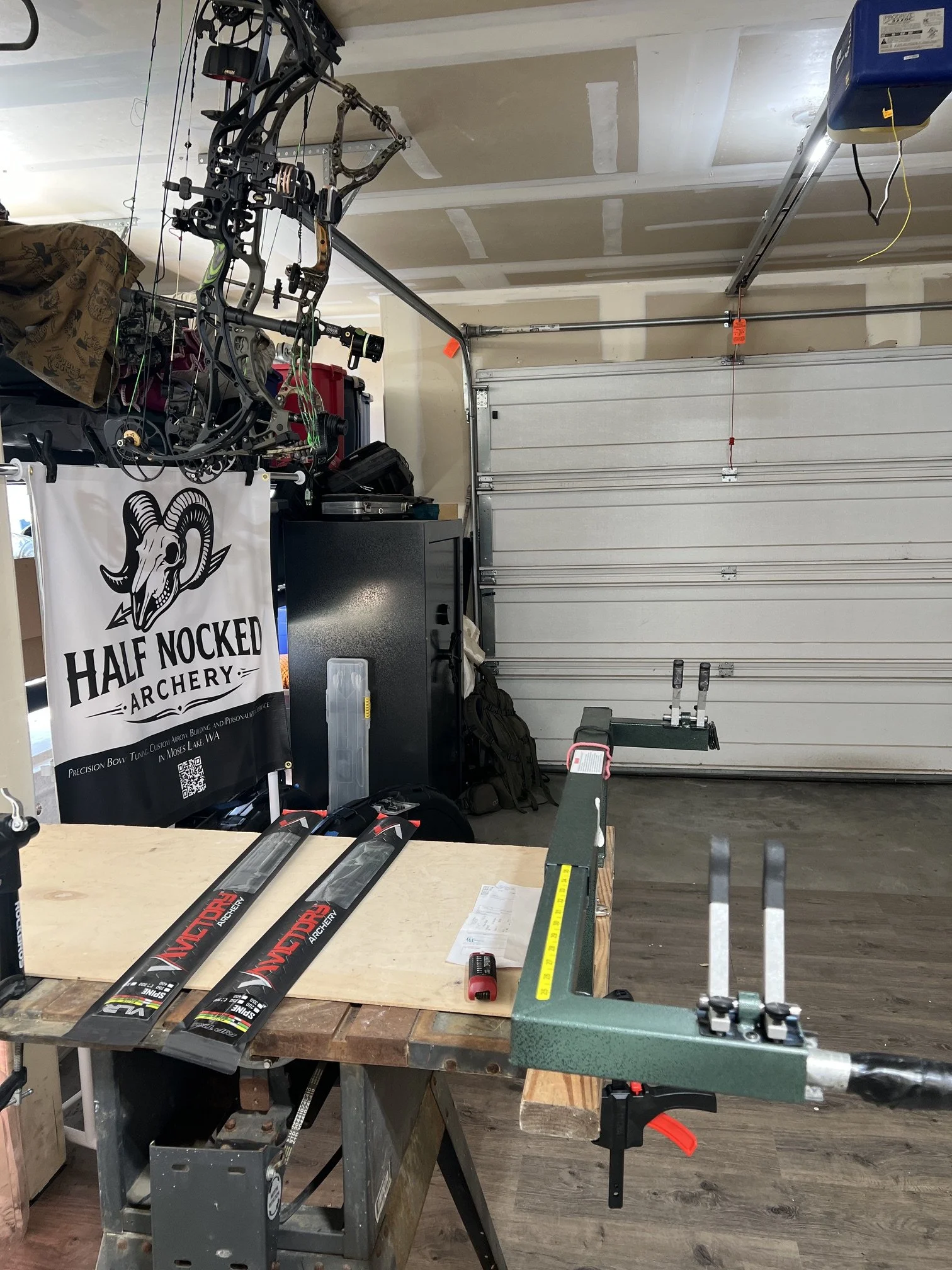
Victory RIP TKO- this might be one of the most popular arrows currently available. A comparable weight to the Easton 5.0, but Victory uses a woven carbon to increase durability. It’s also coated with a ceramic material to make it easier to pull from targets. Made in Vietnam
Victory HLR - this is one of the lightest arrows currently available. It also uses a woven carbon, but it’s a smaller weave which allows the arrow to be lighter and still retain strength and durability. Coated with the same ceramic material as the RIP TKO. Made in Vietnam
-
What is this, and why is it important? A well spined arrow will improve accuracy, improve penetration, and will help to optimize your arrow setup.
Arrow spine is just a measure of an arrow’s stiffness. Smaller numbers mean the arrow is stiffer, and larger numbers mean it’s weaker. With compound bows, stiffer arrows usually perform better, but it’s still important to select the spine that best matches your setup.
Here are a couple of arrow spine calculators, one from Easton and one from Victory. These should be close. Make sure to consider your draw weight and your component/point weight.
If you are still confused, or if you just need some help please reach out. I will happily walk you through everything.
-
Okay, I’m not going to debate the merits of which is better because the internet is full of opinions and more than a few rabbit holes. Just use any search engine or check out ArcheryTalk.
I’m not the foremost authority, but here is what I have found. A 4-fletch configuration does steer a little better in windy conditions, and it can help steer arrows shot from a bow that is poorly tuned. This isn’t a cure-all, but it does offer a little bit more forgiveness. The tradeoff is that your arrow will be heavier, the arrow will be slower, and the arrow will lose energy more quickly. However, if you’re only shooting 20-40 yards none of that really matters , plus sometimes people just like the look of 4-fletch vs 3-fletch.
A 3-fletch is just the standard and is more than capable of steering any fixed blade broadhead. If you need more steering, you can just choose a slightly larger vane.
-
This is really your preference. If you’re chasing the “perfect” arrow setup, the helical direction should match how your arrow clocks. There is some great information from Tooth of the Arrow.
In short, you clock your arrow by figuring out which way your arrow naturally wants to rotate when shot without vanes. After you know that, you set your vanes to rotate the same direction, and a single-bevel broadhead can further maximize that effect. Most bows clock left because of how the string and serving are twisted. If you run left fletching, just make sure to keep an eye on your point to ensure that your components stay snug.
You can also just ignore all of that and simply fletch your arrows with a right helical and not overthink it. Realistically, most shooters won’t notice any difference either way.
-
Oh boy! This is another rabbit hole, think Ford vs Chevy.
Fletched arrows naturally spin as they fly. Giving the vanes a helical twist makes them spin faster, which helps with accuracy and forgiveness. The downside is that extra helical can slow the arrow down a bit, and may add noise. There was a great comparison of vanes and helical configurations done by James Yates and sponsored by Easton. Take a look HERE, it is a worthwhile read.
From my own tinkering, 2°–3° seems to be the sweet spot for accuracy, speed, sound, and forgiveness. I’ve also run 5°–6° before, and while it was extremely stable, it did reduce my arrow speed by roughly 3-5 FPS.
-
All this really means is what proportion of your arrow’s weight is toward the front of the arrow. It’s a bit of a rabbit hole on its own. In most cases, higher FOC helps arrows fly better and hit harder, but you can definitely overdo it. A lot of hunters settle on 12–15% FOC as the sweet spot for most situations. Just remember, having the right arrow spine for that FOC setup matters more than anything else, so the Arrow Spine FAQ is worth checking out.
-
Honestly, if you really want to dig into this topic, check out the James Yates study linked HERE. It explains things better than I ever could in an FAQ.
That said, all of my offerings make excellent hunting arrow setups, so it mostly comes down to what you prefer. If you want a recommendation, just get in touch..